

If you’ve spent any time around cryptocurrency, you’ve probably noticed that prices can swing wildly in a single day. Bitcoin can drop 10% before lunch and recover by dinner. For traders and everyday users alike, that kind of volatility makes it hard to treat crypto as “real money.” This is exactly the problem stablecoins were built to solve.
So, what are stablecoins? A simple guide for beginners starts with one core idea: stablecoins are digital currencies designed to hold a steady value, usually by being pegged to a stable asset like the US dollar. Instead of bouncing around like Bitcoin or Ethereum, a stablecoin aims to stay close to $1, making it useful for payments, savings, and moving money across borders without the rollercoaster ride.
In this guide, we’ll break down how stablecoins work, the different types available, their benefits and risks, and how to choose one if you’re just getting started. By the end, you’ll have a clear, practical understanding of this fast-growing corner of the crypto world — no technical background required.
What Are Stablecoins, Exactly?
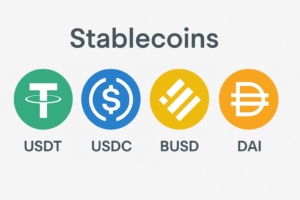
At their core, stablecoins are cryptocurrencies engineered to maintain a fixed value relative to another asset — most commonly the US dollar, though some are pegged to gold, other currencies, or a basket of assets. A single unit of a dollar-pegged stablecoin is designed to always be worth close to one US dollar, regardless of what’s happening in the broader crypto market.
This stability is what separates stablecoins from assets like Bitcoin. . That makes stablecoins a practical bridge between traditional finance and the crypto ecosystem.
Why Stablecoins Were Created
But volatility got in the way of everyday use. Nobody wants to buy a coffee with a currency that might be worth 5% less by the time the transaction confirms. Stablecoins emerged to give crypto users a way to:
- Move value quickly without price risk
- Store funds on-chain without cashing out to a bank
- Trade between cryptocurrencies without touching traditional currency
- Send remittances or payments internationally at lower cost
How Do Stablecoins Work?
Understanding how stablecoins work starts with understanding what backs their value.
Fiat-Collateralized Stablecoins
This is the most common type. For every coin issued, the company holds an equivalent amount of real-world currency (or cash-equivalent assets like short-term government bonds) in reserve. Examples include Tether (USDT) and USD Coin (USDC).
Algorithmic Stablecoins
These don’t rely on holding reserves at all. Instead, they use code and market incentives — expanding or contracting supply — to try to keep the price stable. This category has historically been the riskiest, as several high-profile algorithmic stablecoins have lost their peg entirely and collapsed, wiping out billions in value.
Commodity-Backed Stablecoins
A smaller category, these are pegged to physical assets like gold or silver, with each token representing a claim on a set amount of the underlying commodity stored in a vault.
Popular Examples of Stablecoins
- Tether (USDT) — the largest and most widely traded stablecoin by volume
- USD Coin (USDC) — known for regular reserve attestations and regulatory engagement
- Dai (DAI) — a decentralized, crypto-collateralized stablecoin
- PayPal USD (PYUSD) — issued by PayPal, aimed at mainstream payment use
- First Digital USD (FDUSD) — a newer fiat-backed entrant gaining exchange adoption
Benefits of Using Stablecoins
Now that you understand the mechanics, let’s look at why people actually use them.
Price Stability in a Volatile Market
The most obvious benefit is right in the name. Stablecoins let you hold value in the crypto ecosystem without exposure to the wild price swings common in Bitcoin, Ethereum, and other tokens.
Easy On-Ramp for Crypto Trading
Most crypto exchanges use stablecoins as trading pairs. Instead of converting back to a bank account every time you want to lock in profits, you can simply swap into a stablecoin and stay within the crypto ecosystem.
Access to Decentralized Finance (DeFi)
Stablecoins are the backbone of DeFi lending, borrowing, and yield-generating platforms, allowing users to earn interest or provide liquidity without taking on the volatility risk of other crypto assets.
Reserve Transparency Concerns
Not every issuer publishes detailed, regularly audited proof of reserves.
Regulatory Uncertainty
Regulatory changes could affect availability, redemption, or the legal status of certain coins depending on your country.
Smart Contract and Platform Risk
Crypto-collateralized and algorithmic stablecoins depend on code. Bugs, exploits, or poorly designed incentive systems can put user funds at risk, as has happened in past DeFi incidents.
How to Choose a Stablecoin as a Beginner
- Backing and transparency — Does the issuer publish regular reserve reports?
- Track record — Has the coin maintained its peg consistently over time, including during market stress?
- Regulatory standing — Is the issuer compliant with regulations in major markets?
- Use case fit — Are you using it for trading, payments, or earning yield in DeFi?
For most beginners, sticking to the largest, most established, and most transparent options is a sensible starting point.
Stablecoins vs. Traditional Cryptocurrencies
It helps to see stablecoins side by side with assets like Bitcoin to understand where each one fits:
| Feature | Stablecoins | Bitcoin/Ethereum |
|---|---|---|
| Price volatility | Low (pegged) | High |
| Primary use | Payments, trading, savings | Investment, store of value |
| Value driver | Reserve or algorithm | Market supply and demand |
| Best for | Stability-seeking users | Long-term growth potential |
The Future of Stablecoins
As adoption grows, stablecoins are likely to play a larger role in everyday payments, cross-border commerce, and the broader digital economy.
(Internal link suggestion: link the phrase “how DeFi lending works” to an existing or future article on your site explaining decentralized finance platforms in more depth.)
Conclusion: Getting Started With Stablecoins
Now that you understand what stablecoins are, a simple guide for beginners like this one should give you the confidence to explore them further whether you’re looking to trade more efficiently send money abroad, or dip a toe into DeFi. Start small, choose a well-established and transparent stablecoin, and keep an eye on regulatory developments as this space continues to mature. If you’re ready to take the next step, compare a few top stablecoins on a trusted exchange and see how they fit into your own crypto strategy today.